
Low-temperature service is hard on bolting. A stud that is strong at room temperature can lose toughness as the metal cools. A brittle fastener on a flange, valve, or vessel poses a real risk.
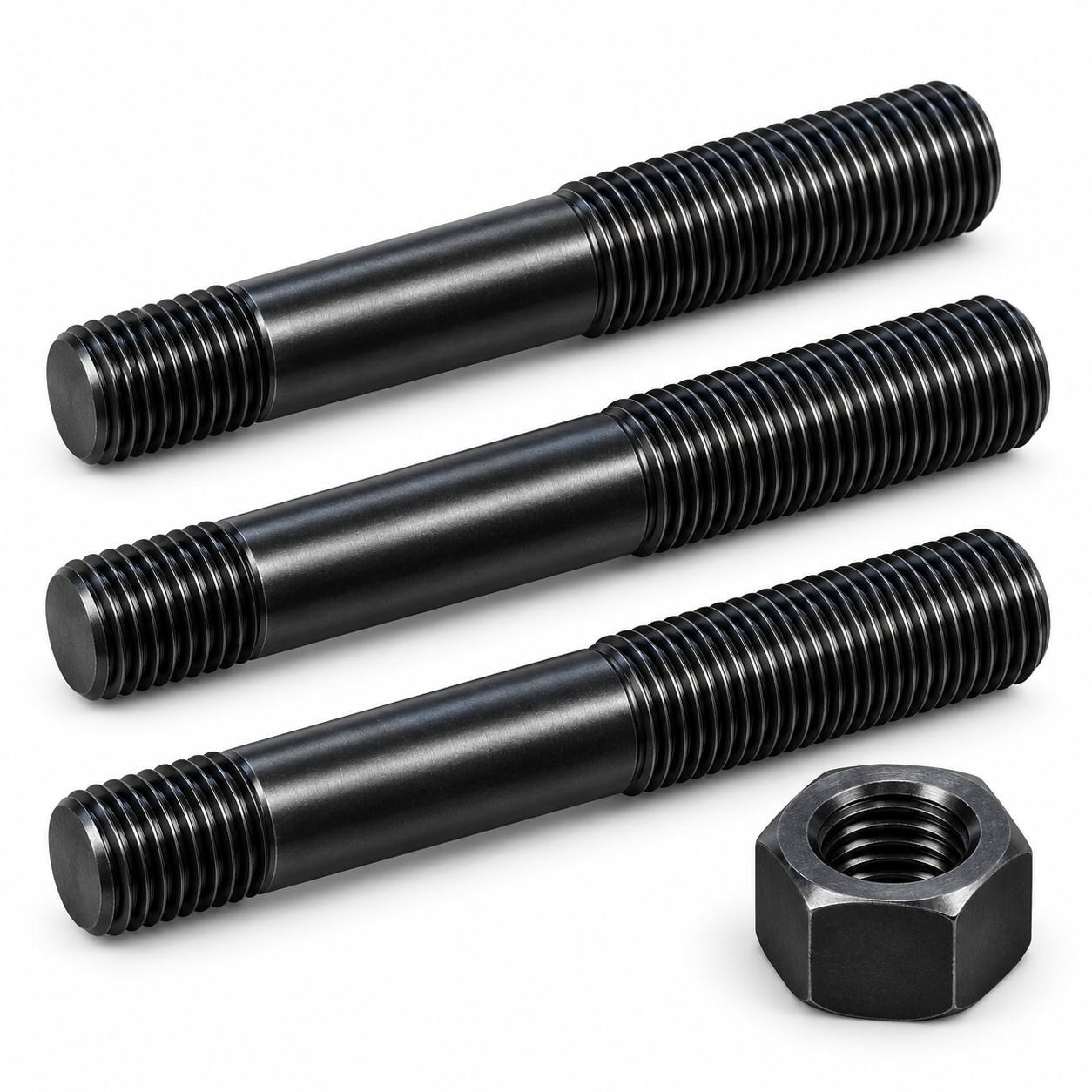
L7 Tap End Studs are made for these joints. They are manufactured from heat-treated alloy steel to meet ASTM A320 Grade L7 requirements, including specified low-temperature impact testing. One end screws into the equipment, and the other accepts a heavy hex nut, allowing assembly where through-bolting is impractical.
For buyers specifying ASTM A320 Grade L7 stud bolts, the tap-end configuration provides defined engagement in a tapped equipment body. For joints requiring continuous threading, see our L7 All Thread Studs guide.
Overview of L7 Tap End Studs
Tap-end studs are threaded at both ends, typically with an unthreaded center shank. The tap-end length, thread fit, and engagement are specified to suit the tapped hole; the exposed end accepts a compatible nut. ASTM A194 Grade 7 refers to the nut material, not the L7 stud material.
Because the stud requires neither a through-hole nor access behind the joint, it suits blind-tapped holes, equipment bodies, and connections accessible from one side. Tap-end studs are a type of double-ended stud; other double-ended configurations may also suit tapped holes when designed for the required engagement.
Standard L7 is supplied with Charpy V-notch impact testing at −150°F (−101°C) within its applicable size range. Clarion checks material certification, impact-test requirements, thread dimensions, coating, and applicable code requirements against your approved drawings and project specifications.
Impact-test temperature is not a universal service rating.
Confirm the minimum design metal temperature (MDMT), size, test requirements, nut certification, and governing design code for the complete joint.
Key Features of L7 Tap End Studs
Tap-end design
One end fits directly into a tapped hole, supporting assembly and maintenance where rear access is unavailable.
Low-temperature toughness
Manufactured to ASTM A320 Grade L7, including specified Charpy V-notch impact testing at −150°F (−101°C) within the applicable size range.
High strength
Quenched-and-tempered alloy steel with minimum tensile strength of 125 ksi and minimum yield strength of 105 ksi for diameters up to 2½ in.
Reliable clamping
Helps maintain bolt preload and gasket compression when correctly designed and installed.
Custom sizing
Diameters, overall lengths, tap-end lengths, thread series, and finishes supplied to your drawing.
Documented quality
Material test reports and heat-number traceability available when specified on the purchase order.
Standards and Compatibility
| Standard / Compatibility | Application |
|---|---|
| ASTM A320 Grade L7 | Material, mechanical, and impact-test requirements for alloy-steel bolting intended for low-temperature service. |
| ASTM A194 Grade 7 / 7L | Compatible heavy hex nuts must meet the applicable impact-testing requirements. The L marking identifies impact-tested nuts; confirm certification for the ordered specification. |
| ASME B1.1 | Unified inch screw-thread dimensions and tolerances. |
| ASME B1.13M | Metric screw-thread requirements, where applicable. |
| ASME B16.5 | Flange and flanged-fitting requirements within its scope. |
| ASME B31.3 | Process piping design, materials, fabrication, examination, and testing requirements within its scope. |
| Custom drawings | Project-specific diameters, lengths, thread series, coatings, engagement, and testing requirements. |
Material standards do not define every tap-end dimension. Specify the thread fit, tapped-hole depth, effective engagement, and clearance to avoid bottoming the stud before the joint is clamped.
Surface Finish Options for L7 Tap End Studs
The coating must suit the lowest design temperature and service environment. Account for coating thickness, thread fit, and the friction conditions used to establish tightening requirements.
| Coating Option | Typical Purpose |
|---|---|
| Black Oxide | Oil retention and a uniform black appearance with minimal dimensional change; corrosion protection is limited and depends on supplementary oil or sealant. |
| Black Phosphate | Oil retention, lubrication, and a controlled surface finish. |
| Xylan Coating | Specified coating systems can provide chemical resistance and reduced friction; confirm suitability for the service. |
| Zinc Plating | General corrosion protection in atmospheric and moderate environments, where permitted by the project specification. |
| Cadmium Plating | Corrosion protection with lubricity, only where permitted by project and environmental requirements. |
Plated high-strength fasteners require an approved process addressing hydrogen-embrittlement risk. Confirm any required process controls and testing with the coating supplier.
Applications of L7 Tap End Studs
L7 Tap End Studs are used in low-temperature bolted joints where the equipment design calls for a tapped connection.
Valves and valve bonnets
Hold bodies and bonnets together in low-temperature service.
Heat exchangers
Secure channel covers, shell flanges, and removable heads in low-temperature service and across temperature swings.
Pressure vessels
Fasten flanged nozzles and closures where the design specifies tapped connections.
Low-temperature piping
Secure suitable tapped flanged joints carrying chilled process fluids, subject to the applicable piping and flange requirements.
Compressor casings
Secure casing joints subject to vibration, using the specified preload and compatible nuts.
Industrial gas plants
Serve equipment handling refrigerated and chilled industrial gases within the qualified temperature range.
Oil, gas, and petrochemical facilities
Serve chilled and low-temperature process units in non-sour service; sour-service selection requires a separate materials assessment.
Low-ambient-temperature installations
Secure equipment exposed to very low outdoor temperatures where brittle fracture is a concern.
Why Choose Clarion for L7 Tap End Studs
Clarion Industrial is a Houston-based company with more than 25 years of experience supplying studs and precision-engineered components. As an L7 stud bolts supplier, Clarion supports standard and custom orders.
Made to your drawing
Diameters, lengths, tap-end lengths, threads, grades, and finishes to your specifications.
Documentation
Material test reports, traceability, and inspection records as required.
Technical support
Help with grade, dimension, thread, and coating selection.
Project-focused service
Support for purchasing teams, engineers, contractors, and maintenance teams.
Request a Quote for L7 Tap End Studs
Send us your requirements so we can review the right configuration. Please include:
- Drawing or sketch
- Diameter and overall length
- Tap-end length and required thread engagement
- Thread type, size, pitch, and fit
- Material grade: ASTM A320 Grade L7
- Coating requirements
- Minimum design metal temperature (MDMT)
- Quantity and delivery timeline
- Required test reports, traceability, and inspection documents
No full drawing yet? Send what you have. Our team will help.
Get Your L7 Tap End Studs QuoteFrequently Asked Questions
What is the lowest temperature for L7 Tap End Studs?
Standard L7 is impact tested at −150°F (−101°C) within its applicable size range. This is a test temperature, not automatic approval for every joint at that temperature. Confirm your MDMT and project requirements.
Are L7 Tap End Studs suitable for all cryogenic uses?
No. Suitability depends on MDMT, impact requirements, the material specification, and the design code. Service below the qualified range requires a separately qualified material selection.
How strong are L7 Tap End Studs?
For diameters up to 2½ in., minimum tensile strength is 125 ksi and minimum yield strength is 105 ksi.
What nuts work best with L7 Tap End Studs?
ASTM A194 Grade 7 heavy hex nuts are commonly paired with L7 studs. Verify the applicable impact-testing requirements and certification; impact-tested nuts carry the additional L marking, commonly written as 7L.
Can L7 Tap End Studs handle corrosive conditions?
Plain L7 has limited corrosion resistance. Aggressive service may require a qualified coating or an alternative material. Confirm compatibility with the full operating environment.